

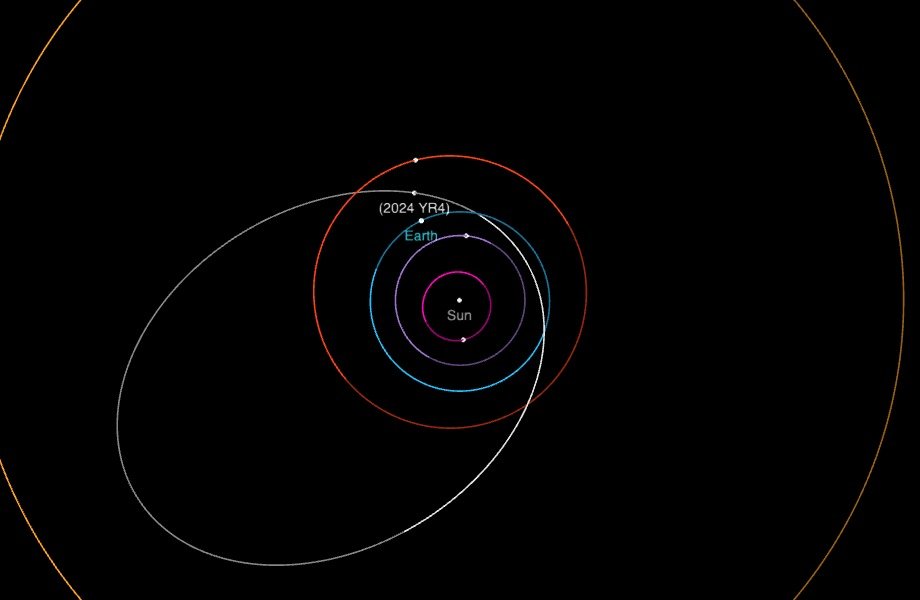


For months, scientists monitored a potentially dangerous asteroid that once carried a small chance of striking Earth in 2032. While that threat had already been ruled out earlier, researchers were still watching another possibility — a collision with the moon. Now, new observations have provided reassuring news: asteroid 2024 YR4 is not expected to hit the moon either.
The asteroid briefly raised concerns among astronomers after calculations suggested a small probability that it could collide with the lunar surface during a close approach in December 2032. At one point, the possibility became serious enough that some researchers even proposed an extreme solution — destroying the asteroid with a nuclear device if necessary.
However, updated data from NASA’s James Webb Space Telescope has helped scientists refine their understanding of the asteroid’s orbit, confirming that both Earth and the moon will remain safe when the space rock passes through the inner solar system in a few years.
Asteroid 2024 YR4 was first discovered toward the end of 2024 and officially reported on Dec. 27 to the Minor Planet Center, the international authority responsible for cataloging newly discovered asteroids, comets, and other small bodies in the solar system. Shortly after its discovery, the object caught the attention of astronomers because of its unusual trajectory.
NASA’s monitoring systems placed the asteroid on the Sentry Impact Risk Table, a database maintained by the agency to track near-Earth objects that have a non-zero probability of colliding with Earth. Among more than 37,000 known large space rocks, 2024 YR4 briefly stood out as the only one with any measurable chance of impacting Earth in the foreseeable future.
At one point, calculations suggested the asteroid had a 3.1 percent probability of striking Earth on Dec. 22, 2032 — an unusually high figure in planetary defense terms. While still relatively small, that probability was enough to attract global scientific attention and increased observation efforts.
Those concerns gradually faded as astronomers collected more data. By late February 2025, improved measurements of the asteroid’s orbit allowed researchers to dramatically reduce the estimated impact risk. The probability dropped so low that scientists effectively ruled out any collision with Earth.
Even after Earth was deemed safe, the moon remained under observation because there was still a slight possibility that the asteroid could strike the lunar surface during its close flyby.
Scientists describe asteroid 2024 YR4 as large enough to qualify as a potential “city-killer.” Objects of this size could cause severe regional destruction if they struck Earth. Observations from the James Webb Space Telescope indicate the asteroid may measure up to nearly 300 feet in length — roughly comparable to a 15-story building.
Because of its size and trajectory, the asteroid became an important target for continued monitoring using some of the world’s most powerful telescopes.
NASA’s James Webb Space Telescope conducted additional observations of the asteroid on Feb. 18 and Feb. 26, gathering critical data that helped refine the object’s predicted orbital path. Those observations allowed researchers to more accurately determine where the asteroid will be when it passes near the Earth-moon system in 2032.
According to a NASA blog post published March 5, the updated measurements show that asteroid 2024 YR4 will safely pass by the moon rather than collide with it.
The asteroid is still expected to come relatively close by cosmic standards. Current projections indicate it will pass about 13,200 miles from the moon’s surface. While that distance may sound extremely close, it is still far enough to eliminate the risk of an impact.
For comparison, the moon itself is located about 239,000 miles away from Earth, making it our planet’s closest celestial neighbor.
The latest analysis was led by scientists at the Johns Hopkins Applied Physics Laboratory in Laurel, Maryland. Their work relies on detailed orbital modeling combined with new telescope observations that reduce uncertainties about the asteroid’s future position.
Earlier calculations had briefly raised concern among astronomers. Initial observations from the Webb telescope in March 2025 suggested that the probability of a lunar impact had increased from 1.7 percent to 3.8 percent.
Those figures came from NASA’s Center for Near-Earth Object Studies, which operates at the agency’s Jet Propulsion Laboratory in California and is responsible for tracking asteroids and calculating their potential impact risks.
The probability increased again later, reaching 4.3 percent after additional observations were made in May 2025. Even though NASA emphasized that such an impact would not have altered the moon’s orbit around Earth, the rising numbers still attracted attention within the scientific community.
The newest observations, however, have effectively eliminated that possibility.
Scientists say the reason the risk has disappeared is not because the asteroid suddenly changed its course. Instead, the improvement comes from a better understanding of its orbit. With more precise data, astronomers can now determine exactly where the asteroid will be when it passes through the region on Dec. 22, 2032.
That refined knowledge confirms that asteroid 2024 YR4 will pass safely by both the moon and Earth, ending years of uncertainty about the object’s potential threat.
Although the asteroid will not pose a danger, scientists say the monitoring process highlights how planetary defense systems work. Continuous observations and improved measurements allow astronomers to gradually reduce uncertainties and accurately predict the movements of potentially hazardous objects.
In this case, the process ultimately delivered reassuring news: a once-concerning asteroid will simply make a close cosmic flyby — without colliding with either Earth or its moon.